
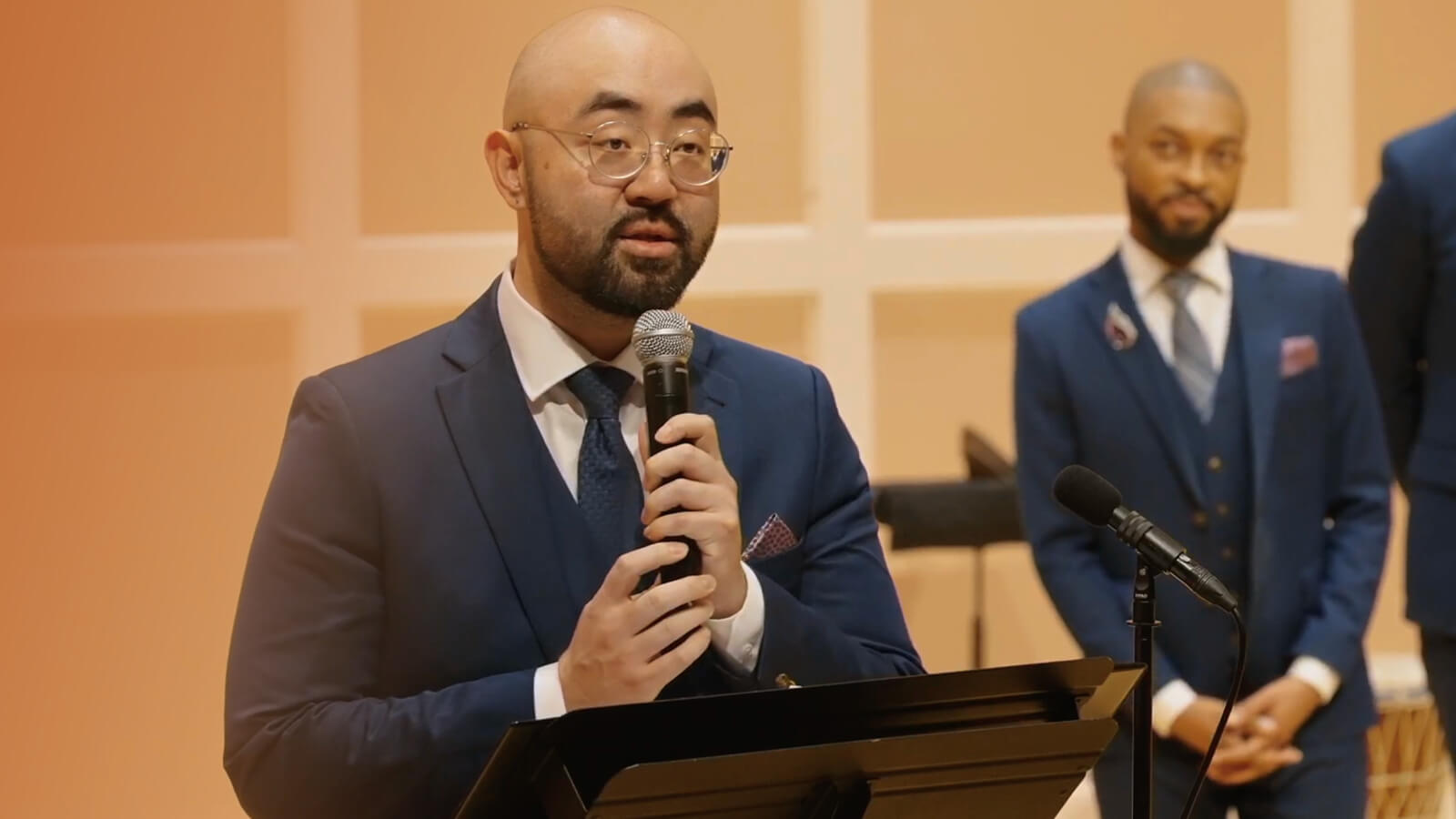
We’ve heard from several audience members who loved Land That I Love and wanted to revisit the text that was delivered from the stage throughout the show. We have gathered them here so you can read, reflect, and enjoy them once more.
THE NEW COLOSSUS by EMMA LAZARUS
Not like the brazen giant of Greek fame,
With conquering limbs astride from land to land;
Here at our sea-washed, sunset gates shall stand
A mighty woman with a torch, whose flame
Is the imprisoned lightning, and her name
Mother of Exiles. From her beacon-hand
Glows world-wide welcome; her mild eyes command
The air-bridged harbor that twin cities frame.
“Keep, ancient lands, your storied pomp!” cries she
With silent lips. “Give me your tired, your poor,
Your huddled masses yearning to breathe free,
The wretched refuse of your teeming shore.
Send these, the homeless, tempest-tost to me,
I lift my lamp beside the golden door!”
— Emma Lazarus (written in 1883)
Excerpt from DECLARATION OF INDEPENDENCE
We hold these truths to be self-evident, that all are created equal, that they are endowed by their Creator with certain unalienable Rights, that among these are Life, Liberty and the pursuit of Happiness.
Opening Speaking Point from ROD KELLY HINES
The Declaration of Independence was signed in 1776. And The New Colossus, whose lines are inscribed on the Statue of Liberty, was written by Emma Lazarus in 1883. Centuries have passed since those words were written and yet here we are, still reflecting on and reckoning with their meaning. What do they signify now? Who are they meant for in a 21st-century America that looks so different from the country that existed when they were first composed? That continues to be a complicated question. And yet, it’s still worth asking. It’s still worth hoping and believing that America can live up to the values—the dreams—expressed in those texts.
When Cantus began preparing this program, we spent a lot of time considering the story we wanted to tell in celebration of the United States’ 250th anniversary. This country is often proudly referred to as a “melting pot,” but at this moment, when you look around it almost feels like that melting pot is boiling over. The noise of division is deafening. The temperatures are rising, and they don’t seem close to cooling down. But as singers, the artists of Cantus know a little something about noise. And we also know that with patience, with empathy, and by closely listening to one another, what begins as utter cacophony can be transformed into the most beautiful harmony. And that’s the spirit that inspired this program. This idea that by embracing diversity, by leaning into, and celebrating the richness of our varied cultures and perspectives, we can break down barriers and see the human traits that connect us all.
Most of the music you’ll hear on this program was written by first- and second-generation immigrant composers. Several of whom have also taken the time to write reflections on what it means to live, create, and belong in America. To contextualize and situate themselves within an American culture made up of many languages, many cuisines, and many traditions that people bring with them when they become citizens of this country.
The ideals set forth in 1776 sometimes feel more like questions than realities. But they also represent the aspirational dream at the core of our national identity, a dream that belongs to each and every one of us.
Reflection from composer SAUNDER CHOI
I moved to Boston in January 2012—deep in the heart of winter—straight from the tropical warmth of the Philippines. That transition marked the beginning of a new chapter, one filled with excitement, but also with a quiet, persistent longing for the familiar.
That longing sparked a search—for echoes of home in food, in community, in the arts. Fortunately, my housemates were also Filipino immigrants, and together we began to weave connections with the broader Filipino-American community across Greater Boston. At the time, the nearest Filipino market was in Worcester, and not a single Filipino restaurant could be found within a hundred-mile radius. If you wanted Filipino food, you found it in someone’s kitchen, after the Filipino Mass at Boston College, or cooked it yourself.
Looking back, it feels inevitable that my first published choral work in the U.S. would be an arrangement of a Filipino folk song—a beloved children’s tune known to generations of Filipinos. It was a small act of remembrance, a way to give voice to that quiet yearning. I completed the piece in time for the Philippine Madrigal Singers’ 2013 U.S. tour, which included a stop in Boston!
— Saunder Choi, arranger of “Leron, Leron Sinta”
Reflection from composer CARLOS CORDERO
The languages switch:
Since I was a child, I’ve always loved learning languages. They are like a code that helps me connect with others (or prevents me from understanding them when I don’t know). I remember feeling excited when learning English and having access to a whole new world. The same happened later when I learned French. I felt powerful and ready for more. I had to stop there for a while though because I moved to the US and my brain needed to focus on English.
While connecting with more Latine people, it was interesting for me to always prefer to keep communicating in English because of our context (United States). It took me so long to let go and choose Spanish as my first option. I think some part of me was afraid I wouldn’t be able to smoothly come back to English.
Now, I feel comfortable and confident I can speak both languages thanks to the people who pushed me to try. My boyfriend Tomás helped me reconnect with the feeling of being home through speaking more Spanish. My mom is currently visiting for a few months. She has helped me to solidify the joy of using my mother tongue all the time and to use it as a way to bring more of myself to my “English side.”
I hope we get to keep building a future where I can find more languages around, more people to connect with, and more moments to practice the awesome power that language switch is.
— Carlos Cordero, composer of “Lejanas Voces”
Reflection from composer MELISSA DUNPHY
My immigration and naturalization process spanned almost six years. After falling in love with a handsome American in 2002, we exhaustively researched how I might immigrate to the United States. The easiest method at the time was the K-1 Visa, more infamously known as the 90-Day Fiancé(e) Visa.
Six years and thousands of dollars later, in late 2007, I became eligible for citizenship. It’s difficult to describe to natural-born Americans how much perseverance is necessary for a—quote—“alien spouse” to become a fully-fledged American citizen. Even when applying through the easiest methods, the process is expensive, stressful, and at times even traumatizing.
I wanted to become a citizen because I love this country, but in order to do so I had to scale walls of inhuman and inhumane bureaucracy without any guarantee that at the end of that journey I would truly be seen as American by those who were born here.
I am legally an American, but I had to take a test and swear an oath and jump through sometimes Kafka-esque hoops to enjoy a citizen’s rights.
As hard as it was, I am so proud to say that I earned my citizenship, and I take my oath seriously: “I will support and defend the Constitution and laws of the United States of America against all enemies, foreign and domestic; that I will bear true faith and allegiance to the same.”
— Melissa Dunphy, composer of “N-400: An Erasure”
Excerpt from ON THE PULSE OF THE MORNING by MAYA ANGELOU
A Rock, A River, A Tree.
Hosts to species long since departed. The dinosaur, who left dry tokens of their sojourn here on our planet floor. Any broad alarm of their hastening doom is lost in the gloom of dust and ages.
But today, the Rock cries out to us, clearly, forcefully: Come, you may stand upon my back and face your distant destiny, but seek no haven in my shadow. I will give you no hiding place down here.
You, created only a little lower than the angels, have crouched too long in the bruising darkness; have lain too long face down in ignorance. Your mouths spelling words armed for slaughter.
The rock cries out today: You may stand on me, but do not hide your face.
Across the wall of the world, a river sings a beautiful song: Come rest, here, by my side. Each of you a bordered country, delicate and strangely made proud. Come, clad in peace and I will sing the songs the Creator gave to me when I, and the tree, and stone were one. Before cynicism was a bloody sear across your brow, and when you yet knew you still knew nothing.
The river sings and sings on.
Today, the first and last of every tree speaks to humankind: Come to me, here beside the river. Each of you–descendant of some passed on traveller–has been paid for.
Here, root yourselves beside me. I am the tree planted by the river, which will not be moved.History, despite its wrenching pain, cannot be unlived, and, if faced with courage, need not be lived again.
Lift up your eyes upon the day breaking for you. Give birth again to the dream. Take it into the palms of your hands. Mold it into the shape of your most private need. Sculpt it into the image of your most public self. Lift up your hearts. Each new hour holds new chances for new beginnings. Do not be wedded forever to fear, yoked eternally to brutishness.
The horizon leans forward, offering you space to place new steps of change. Here, on the pulse of this fine day, you may have the courage to look up and out upon me: the rock, the river, the tree, your country. No less to Midas, than the mendicant. No less to you now, than the mastodon then.
Here on the pulse of this new day, you may have the grace to look up, and out, and into your sister’s eyes, into your brother’s face–your country–and say simply, very simply, with hope:
Good morning.
— Maya Angelou
Reflection from composer SHABNAM ABEDI
Identity is something most of us question at some point in our lives because identity gives us a sense of belonging.
We have a predetermined physical form of identity and our internal (the mental and emotional) form of identity- that then creates the foundation of how we interact as humans…all of which we get to choose. We get to define and choose the meaning behind our predetermined physical form.
For example, short doesn’t have to mean you take up less space and large doesn’t have to mean you step over others. Internal forms of our identity dictate what social norms we prioritize, what forms of lifestyle we practice, what we believe we should eat, how we should communicate, what we should wear, etc.
My experience growing up as a first-generation Bangladeshi-American kept identity at the forefront. How do I belong? There were trivial questions like…do I identify with short or long hair? Do I identify with rock or R&B?
Bigger questions like…do I identify with what being culturally American stands for or do I identify with what being culturally Bangladeshi stands for?
After many takes of questioning and many attempts to belong to a definition of identity that the world is comfortable with, I realized that my identity is a multidimensional, ever-changing and ever-expanding sense of belonging.
I don’t belong to any one political land, I belong wherever I hang my hat. I don’t belong to one way of obligatory living, I belong to healing and growth. I don’t belong to Americanism or Bengalism, I belong to the creation of culture. I don’t belong to the patriarchal or matriarchal understanding of womanhood, I belong to my understanding of being a woman. English belongs to me just as much as Bangla belongs to me just as much as Spanish would belong to me if I spent the time to learn it.
I have repeatedly made the mistake of trying to have an identity that I could easily explain to someone, but I am not an explanation…I am a whole story—a story of belonging to love.
— Shabnam Abedi, composer of “Manush Dhoro, Manush Bhojo”
Excerpt from CANTO by FRANCISCO X. ALARCÓN
guided by the scent of hope
to even meet up with strangers
and arrive at yesterday and find
ourselves ashore, bathed in future
and to see in every face a door
open and inviting us in
to find solace in memories
like bread and water, a bed, the sun
and to run out, barefoot, into the year’s
first rains to embrace tenderness,
and offer shade, joy, strength, support like
solid, mountain oaks
and to flourish like tilled soil,
and to be anchor, oar, compass and sea,
and sing the wind’s true song
with one voice, in the face of silence––
we’ll only be free when every man
and woman, in every home, street, every
shade of the human race, everywhere, is truly free
we’ll only be free when abuse, loneliness, hunger, alienation
aren’t words, but forgotten rumors of a far, distant past
we’ll only be free when we become little boys and girls once again
who squirm with joy as we explore the marvels, the wonders of the world.
— Francisco X. Alarcón
Reflection from composer YOSVANNY ESTEPE
I was born in Havana, Cuba, or at least that’s what people tell me. But I know the truth: the Stork actually made a monumental mistake. If I remember correctly, I slipped from her beak, she wasn’t able to catch me, and, well, I landed on the island…
I studied at the National School of Music in Havana and later was a professor of Theory and Solfege at said institution. Almost finished with my degree, I started to play with a renowned band on the island, with whom I had the opportunity to visit Guadalajara, Mexico. Not just anybody could leave the country during those years. You needed a highly justified, accepted, and authorized reason to gain permission from the Cuban regime. Ultimately, everything needed their approval.
For obvious reasons to those of us who have lived under communism, I decided not to return and start a new life in Guadalajara. I spent 17 years in Mexico, where I was able to accomplish much more than I had dreamed possible while living in Cuba.
For about 7 years now, I have been living in the US with my wife, and “for my wife,” since it was never my intention to live here initially. But love convinced me.
I truly feel blessed, among other things, for the ease with which this country has allowed us to carry out our projects, to have my wife with me always, for her beautiful voice (believe me), for her pure and clear soul, and for the pride I feel in being able to be an American citizen.
I cannot deny that at first, the change of country was very shocking for me: leaving behind everything I had built and accomplished in Mexico, starting from zero again, a new culture, new customs, THE LANGUAGE (and by “language” I don’t just mean English; I mean Southern English)… But the liberty and the respect for the law that you breathe in the US, I dare to say, do not exist the same in any other part of the world.
I know very well what it is like to live without liberties or rights and everything that produces. For that reason I am grateful to be one more citizen of this great country.
— Yosvanny Estepe, arranger of “El Manisero” and “Mi Tierra”.
Join us for our beloved holiday program Christmas With Cantus, which the Minnesota Star Tribune deemed “as joyful a celebration of the season’s spirit as any caroling party you’re likely to attend this year.”
DECEMBER 12-22, 2025
In-person and online options available

Recent Comments